Image Credit: NY Times and The Mirror
The UK is in the (swelteringly) hot seat; our government’s actions now will shape our future on this, our only home!
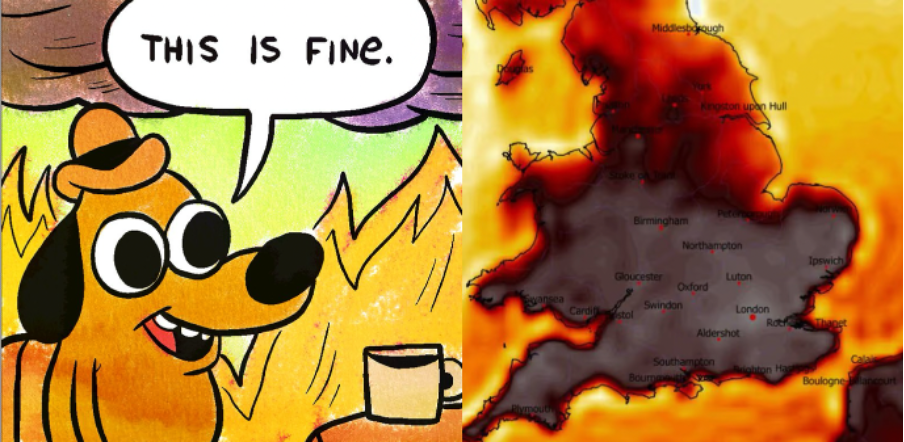
The recent heatwave sweeping across Europe has shattered records across the continent. The sizzling35.1C recorded at Kew Gardens set a temperature record for May, breaking the long-held title of … the day before.
The record hot Summers of recent years ‘will become the new normal’ as ‘heat waves could regularly exceed 40°C’
Coming hot on the heels after the UK’s eighth wettest winter on record – and, as you may be unsurprised to hear, Warwickshire’s second wettest winter – we have certainly experienced rather uncomfortable weather whiplash.
These extremes bear witness to the UK’s rapidly changing climate, a development only set to continue.
Going into the century, heavy rainfall throughout the year will be significantly more intense, increasing the risk for flash flooding. You only need look to Ironbridge in 2020 or to the ‘uninsurable’ Tenbury Wells for evidence of this worrying trend. Rising sea levels (20-45cm higher than today by 2050!) will also increase risk of coastal flooding and erosion.
The Climate Change Committee’s (CCC) ‘Fourth Independent Assessment of UK Climate Risk’determined that ‘92% of existing homes’ are not prepared for the increasingly wet Winters and the longer, more intense dry spells lasting from Spring through to Autumn.
Essentially, the UK needs to prepare for the oncoming storm whilst it is still (relatively) calm. So what caused May’s record-breaking heatwave?
Europe has been ‘warming by 0.56C per decade’ since 1990, over double the global average, making ours ‘the fastest-warming continent’.
It is easy enough to place blanket blame on climate change; however, without getting lost in meteorological jargon, let’s look at the phenomena causing this heat.
The current El Niño (the cyclical warming phenomenon of the Pacific Ocean) may receive the designation of ‘super El Niño’ (when the ‘three-monthly average of sea surface temperature’ exceeds 1.5C), with predictions of a record 3C warming.
There is a strong association between a warming El Niño and increased global temperatures. The current swelling cycle could lead to ‘record global temperatures next year’ with humanitarian consequences much more devastating than those in the UK. António Guterres warned that ‘El Niño conditions will pour fuels on the fire of a warming world’.
Looking to the ocean on the other side of the globe, the AMOC (Atlantic Meridional Overturning Circulation) temperature and weather regulating conveyor belt, is now slowing.
This may lead to disrupted weather systems on which crop production in many parts of the world rely and, contrary to ‘global warming’, a very chilly future for Europe.
It is clear that the UK is tumbling towards unprecedented climate upheaval with more extremes and significant challenges for agricultural disruption, building adaptation, and environmental degradation.
The impacts of climate change – not exclusive to a slowing AMOC and increasingly harsh super-El Niño cycles – will lead to massive humanitarian crises across the globe.There can be little argument then that tackling climate change requires a unified global response…
In light of this, there is good news that, in May, the UN General Assembly voted overwhelmingly in favour (141 votes) of the ICJ’s 2025 ruling that ‘States have an obligation to protect the environment from greenhouse gas emissions’.
The resolution – brought to the UN by Vanuatu – received only eight votes in opposition, with Trump’s petro-America filing in amongst the likes of Russia, Iran, and Israel. The UK backed the resolution.
Nevertheless, the 30th Climate Change Conference (COP30) held in Belém last year went down as one of the most disheartening multilateral climate events, failing to attribute global warming to fossil fuels.
However, with over 5,000 indigenous participants, there was inspiring collaboration between the local and grassroots representatives and the multilateral global action facilitated by the UN. Prioritising grassroots voices – whether its Vanuatu or the indigenous peoples of Brazil – and targeting aid to those most affected will provide a clearer direction for effective and just climate action, for the world and the UK.
Talking about climate change is tricky; accusations of fear-mongering or existential worrying must, however, be grounded in the very real challenges we now face.
Quite often, we find ourselves feeling powerless, and that we are unable to affect meaningful change against great systemic forces and the chimney plumes of mega-corporations and industry.
I would like to challenge this narrative though: there is massive potential for optimism in our future and you can have a say. So … short of instigating a mythology-worthy fight against the oceans and weather, what can you do?
Vote!
Voting is one of the easiest and perhaps one of the most powerful levers on our Government. We know that salience precedes change. Advocating for the cause, writing to your MP, are examples of the many ways you can have meaningful influence on the UK’s policy direction.
It is incumbent upon us, as a globally-wealthy climate leader, to support international action and confront the unprecedented environmental challenges to which we must now turn the prevailing winds against.