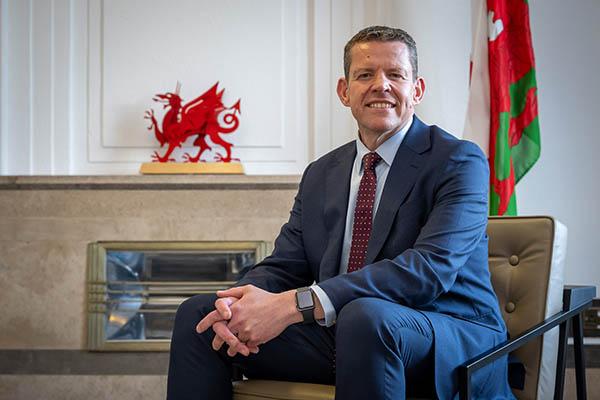
Image credit: Welsh government
What should we do when the unthinkable happens? The 7th of May elections in Wales and Scotland pose many such questions, one that the Labour Party must now answer following their historic loss of the Welsh parliament for the first time since the successful devolution referendum in 1997. This was an abject failure of massive proportions for the party in government, reduced to just 9 seats in the Senedd after decades of dominance in the nation.
For Plaid Cymru however, this is a time of celebration as they picked up 43 seats – just six short of an overall majority. The Welsh nationalist party have now formed a minority government under the leadership of Rhun ap Iorwerth following his successful nomination for First Minister. Time will tell whether the centre-left governance of Plaid will be successful – as a minority administration they will be forced to fight for every one of their manifesto pledges through deals with other parties.
The obvious foil to their plan for government will be the far-right Reform UK party who came in second, picking up a significant 34 seats. Their leader in Wales, Dan Thomas, has promised ‘robust opposition’ to the new governing party. This will be an issue for all opposition parties as they seek to rebuild trust with the voters who overwhelmingly rejected their politics.
In doing so, they would most certainly not want to be seen siding with Reform. The party of such pledges as to open migrant detention centres in areas that vote for the Green Party. Let us not forget too their previous leader in Wales who has now been sentenced to 10 and a half years in prison for taking bribes from Russia to make positive statements about the country during his time as a MEP.
It is important to note that Plaid, despite being an explicitly nationalist party, are not seeking independence for Wales in their first term. Instead, they are seeking to make the case for it through effective governance, but time will have to tell if they succeed. Although, if this election is anything to go by, they will certainly hope to maintain the good will of the public that placed their trust in the Party.
The results for Labour in Scotland are less devastating than in Wales, but they still highlight the sheer level of discontent that the public now harbours for them. Following the General Election in 2024, it was thought that the SNP may never recover as a public scandal enveloped the party’s leadership over financial irregularities. This led to the husband of then-leader Nicola Sturgeon, Peter Murrell’s, arrest and charge with embezzlement in 2024. He is currently released on bail.
However, it seems that the Party has made a remarkable recovery. Under the astute leadership of FM John Swinney, and alongside the failures of Labour in Westminster, the SNP maintained their plurality by winning 58 seats in Holyrood. They have now formed a government seven seats short of a majority, with the next most popular parties (Labour and Reform) sitting at 17 each. The SNP will seek to continue their dominant streak in the Scottish parliament, with their clear intent being a second independence referendum as soon as possible.
Relying on the similarly pro-independence Scottish Green Party, the Bute House Agreement that agreed to share power was terminated by former SNP FM Humza Yousaf. With one of the most commonly cited reasons for the breakdown being the two parties’ disagreements over the disputed Cass Review into the medical care of transgender children.
Such squabbles will no doubt be raised again by opposition parties in Holyrood, but it is up to the SNP and Greens to put their differences aside and work together for the benefits that greater Scottish sovereignty will bring.
Positive steps towards co-operation are already being taken, indeed the leaders of each of the devolved nations of the UK recognise the importance of greater collaboration between them.
Nationalist parties now control the Senedd in Wales, Holyrood in Scotland and Stormont in the North of Ireland (under Sinn Féin). Indeed, the respective leaders have met with FM Michelle O’Neill to discuss greater collaboration between the nationalist groups that will no doubt result in greater sovereignty.
In this time of great political imbalance, it seems that voters across the UK have firmly rejected the disastrous path of the government in Westminster. They have overwhelmingly backed parties that favour independence for the nations across the UK,and it is now up to whoever the Prime Minister is to either accept demands for greater devolution or force the eventual dissolution of the Union.
Whichever path the government chooses, prosperous times are ahead for the devolved nations of the UK in the hands of parties that have been and will continue to work in the interests of their own people – no longer allowing them to be exploited to line the pockets of the treasury in England