
Having recently watched Ryan Gosling’s new sci-fi dystopic film Project Hail Mary, it won’t come as a surprise to tell you that I am now fascinated by Space exploration – because believe me, a bit of Gosling can make anything seem cool!
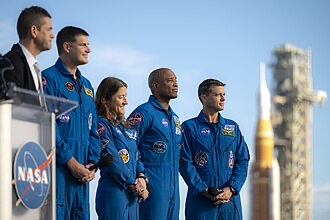
On a serious note, with apologies for my bromance, fanboy tangent (tell me I’m wrong though!), I watched the live stream of the Artemis II astronauts on Sky News, and there are few other things that have captured my imagination so vividly.
BBC journalists Rebecca Morelle and Alison Francis noted there has been an internationally prevailing feeling of ‘been there, done that’ regarding the Artemis mission, whose aim is to carry out the necessary checks for the first moon landing in over fifty years in 2028.
It must indeed be admitted that Space exploration is inherently political (to which anyone who studied the Cold War in GCSE History can attest). A strong argument can be made questioning whether a $4 billion mission is the US government’s main priority, when 37 million of its citizens are living below the poverty line.
It is not my intention to impose upon you a cynical view of humankind’s great search beyond the stars. Thus, I will attempt to convince you of the continuing shared value of Space travel the only way I know how – with some good old statistics!
The four Artemis II astronauts (Victor Glover, Christina Koch, Reid Weiseman and Jeremy Hansen), easily surpassed the furthest distance humans have travelled into Space – reaching an incredible 252,756 miles from Earth. Their objective was to study the dark side of the moon (for those of you thinking about Pink Floyd, you should be ashamed of yourselves!), to study its craters for valuable minerals and prepare their Orion capsule for NASA’s imminent moon landing.
Scientists like British chemist Helen Sharman will preach to you that ‘If we really come together, we can produce so much that’s beneficial to humankind’. Indeed, NASA sees the Artemis missions as an important stepping stone through which we can learn to sustain life on Mars, once we’ve all wrecked this planet.
However, whilst I support Sharman’s assertion that Space travel is one of the few unifying forces we have available to us, let’s indulge its political aspects for a moment.
In the last year, the US dollar has fallen in value by 11%. As of March 2026, American national debt has reached $39 trillion. NASA (as we have seen), spend billions funding their Space programs quite unscrupulously. You will be unsurprised to hear that NASA is considering two models of lunar landers for the Artemis III mission in 2027 – Elon Musk’s SpaceX Starship, and Jeff Besos’s Blue Origin. It appears once again that the majority suffer while the pockets of the rich are lined.
Someone bring me a copy of the Communist Manifesto! Like any good socialist I feel the urge to read a bit of Marx just to calm down.
Anyone who has watched Steve Carell’s Space Forceon Netflix, will also be aware that lunar exploration could ultimately lead to the irrevocable rupture of international diplomacy. The UN Outer Space Treaty (1967) currently stipulates that no country can claim ownership of the moon.
However, when astronauts of any country land on the moon, they can (under the terms of the treaty) enforce an indefinite ban on encroachment of their territory by other countries in the interests of ‘scientific research’. Many of the nations at the forefront of the BRICS alliance are planning lunar landings for the 2030s and 40s – make of that what you will!
So the Artemis mission will lead to the eventual colonisation of the moon and the abandonment of Earth altogether. Is that what you’re telling us Alex? In that case I should probably book my tickets to Mars now, especially if I want a window seat.
That’s absolutely not what I’m telling you. The global media attention generated by the mission and its four brave astronauts represented the first time in a long time that the world seemed to unite for the betterment of humanity.
Yes, exploratory Space missions do cost what economists would call a lot of money. But no, they are not the reason why nearly 850 million people worldwide live in extreme poverty.
Even if we contain the problem to the USA (which we seem to be doing a lot lately), NASA’s expenditure does not represent the government’s misguided priorities. Don’t you think we should look elsewhere for those?