
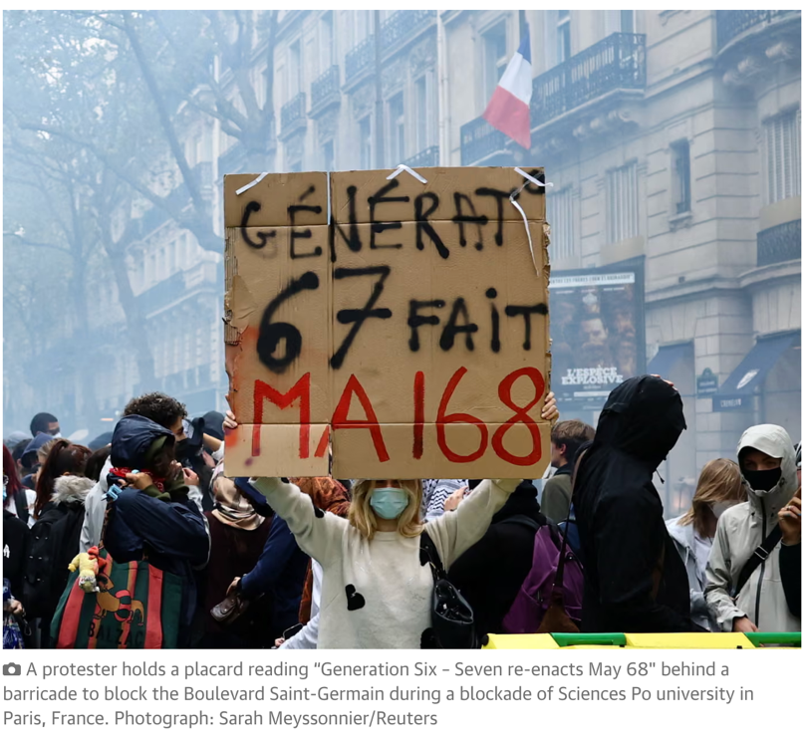
Photo Credits: Guardian
The French have a legendary reputation for their protests: it is woven into the country’s cultural fabric. This past month has made no exception. Alongside a historic papal visit, Paris fashion week, and pride parades, France has been swept up by a massive current of student protests.
The protests come as the lycéens (highschoolers aged 15-18) face insufficient infrastructure, worsening standards of education, harsh timetables, and what many deem to be an unfair university admissions process.
Students and teachers alike have long been struggling with dilapidated infrastructure. Even though state expenditure on education is 28% higher than the OECD average, up to 20% of all school buildings are considered to be in ‘serious need of renovation’: with reports of vermin, mould, and classrooms freezing in Winter or reaching a sweltering 40°C during the Summer Circulating the media.
The protests began in Créteil, an eastern suburb of Paris, where highschoolers blocked their school on the 17th of September, only weeks after the national return to school. Since then, 90% of universities Have been blocked or closed and the protests have spread massively, now encompassing 450,000 protestors Including high schoolers, parents, university students and trade unionists.
Their message is clear: unwavering solidarity with the students.
Despite this, the beginning of October saw the release of the government’s proposed draft budget for 2027 which would cut 1,588 teaching posts. Edouard Giffray, Education Minister, has defended these proposals as means to balance funding across the education system, promising 3,000 replacement teachers. However, many students have deemed this unfortunately timed ‘anti-social’ budget an infringement upon or even a dismissal of their very concerns just as tensions were growing.
The protests have culminated in the events of the 17th of October, seeing up to as many as 800,000 people take to the streets across France.
Unfortunately, the political response has been less responsive to the concerns of nearly a million protestors, and disproptionately focused on the violence of a minority, spurred on by heavily condemned looting and burning of public buildings with more than 1,800 arrests. Similarly, 75% of TV channel France 2’s coverage has focused on violence, indicative of the media’s depiction of the movement.
As anyone following the protests will have unavoidably seen, the police response has been shocking. Stun grenades and a liberal use of tear gas have been launched onto crowds of young protestors, with four children ‘mutilated’, reports of sexual violence, and many injuries sustained amongst the protestors and police.
The Government’s response has been characteristically unsympathetic, predictably focusing their narrative on youth violence rather than their demands.
The Prime Minister, Sebastien Lecornu, regretted these ‘accidents’, a comment that provoked some deputies to call him ‘the shame of the Republic’. Similarly, Laurent Nuñez, the Interior Minister, defended the ‘proportionate’ police response. Nuñez has since tendered his resignation following the 17th of October, although this was refused by President Macron.
The proportionality of the violent police response appears weaker however in light of concern expressed by Amnesty International about the crowd control techniques used, with Jean-Luc Melanchon, leader of the left-wing party La France Insoumise, stating that “confrontation seems to be the aim of their strategy to ‘maintain order’”.
However, despite the few incidents of violence, the main take-away should reflect the mostly peaceful, energetic, and creative democratic expression protesting against a deeply unpopular police response and government.
The adoption of the phrase ‘Bismillah, c’est les ténébres !’ (Bismillah, it’s the darkness!), an absurd and out of touch undercover police message alongside scenes of crowds singing Darth Vader’s Imperial March in the face of heavily armoured police show the light-hearted mockery of a villainised police response.
Symbolically, the movement has appropriated the ideas of the Republic. Scenes of crowds brandishing the tricolour flag, singing the Marseillaise in front of police forces, and dressing the Place de la République’s Marianne in a yellow vest powerfully position the protestors as the democratic citizens and inheritors of the Republic.
On top of this, groups of musicians, appearances from the MCU and DC comics, and aura battles (to Greta Thunberg’s great enjoyment) have made for a uniquely Gen Z movement.
Many have made the link between this ‘Gen 67’ and the romanticised protests of ‘Mai 68’. Calls of ‘Adieu, de Gaulle !’ are echoed in ‘Macron, démission !’ (Macron, resign!), as both movements have responded to unpopular presidents, whilst blockades of lime bikes on the street are perhaps a 21st century manifestation of the famous ‘nuit des barricades’ of 1968.
The mood, however, seems to be different. Whilst the protestors of 1968 were optimistically casting aside outdated social structures for a brighter future, the current movement reflects concerns for education prospects and anxieties about an uncertain future.
In the short-term future for the movement, state schools have entered two-week long holidays potentially slowing the movement’s momentum. Some have interpreted the government’s strategy as delaying into this break.
However, this reliance on Gen Z’s supposed short attention span may be representative of the ‘infantism’ expressed against the youth. Student Unions have proposed this time as an opportunity to ‘refocus their dynamics and grievances.’
Looking forward, these tensions come at an important time in the presidential election cycle, as Macron enters into his final six months as President.
Both right-wing and left-wing parties have sought political gains from the movement. Le Pen’s far-right Rassemblement National have capitalised on the violence, calling for a harsher response and the ‘end of impunity’; even Trump and Farage have chimed in with their usual unsolicited comments about ‘migrant chaos’.
The left-wing party, La France Insoumise, however, has been present across the movement, standing arm-to-arm with students, amassing wide-spread support from under 35s.
With the young inheritors of the Republic facing under-supported schools and an uncertain future, these student movements mark an important moment in the political history of France.
Amidst Gen Z protests across France, India, Spain, Albania, Chile, and Brazil, it is clear the youth will no longer accept indifferent and unsympathetic governments to decide their future without them.

Leave a Reply