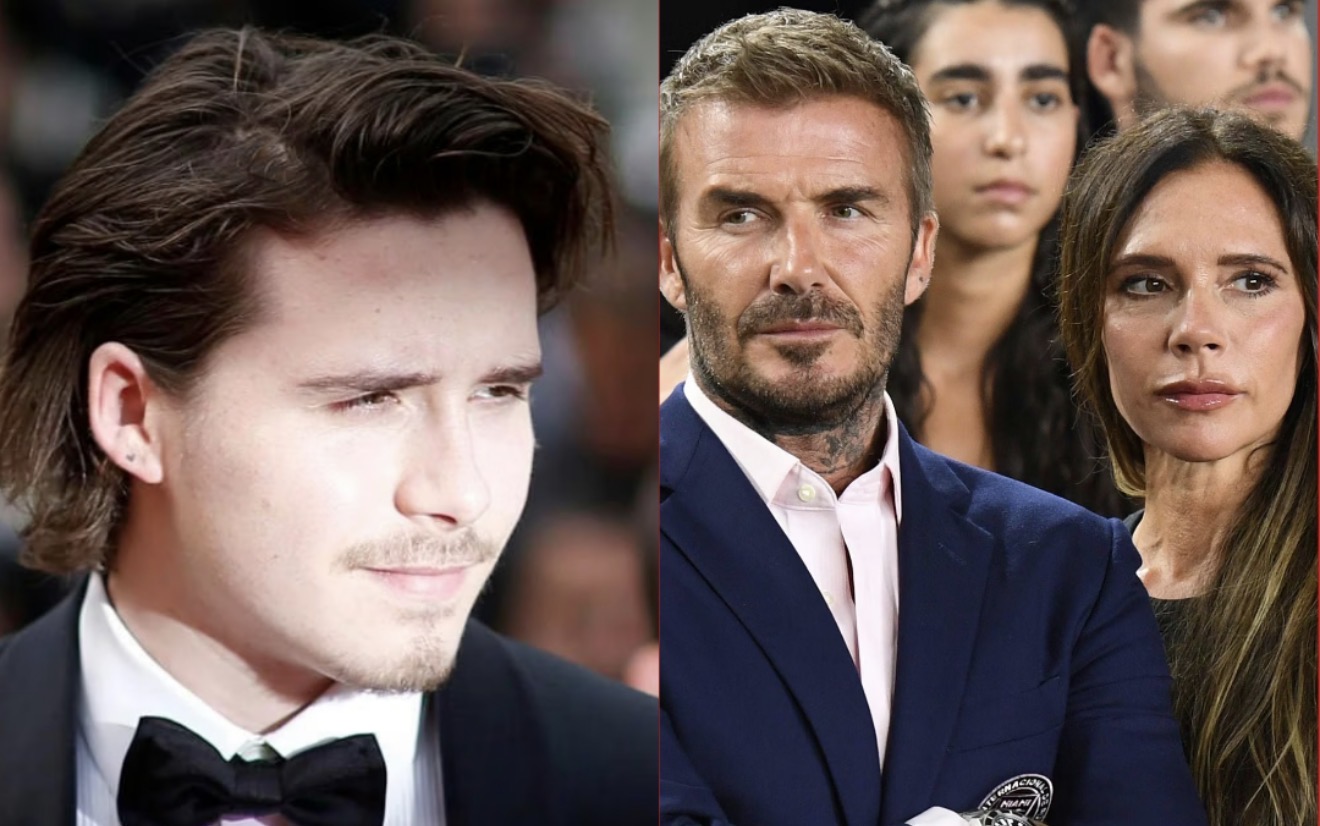
Pictured: Brooklyn Peltz Beckham, and David and Victoria Beckham
Image credits: Heute.at [edited]
Entering into the pop culture lexicon in 2022, the term ‘nepo baby’ was first coined in
a post on X (formerly Twitter) regarding the parentage of up-and-coming actress
Maude Apatow, namely, that she was the daughter of prominent director Judd
Apatow and actress Leslie Mann. Ever since, we have been inundated with a constant discourse surrounding those who have been labelled ‘nepo babies’, with various publications having sought out their response to the label.
It is a discourse that inevitably seems to arise every time the supporting cast of a new Wes Anderson or Sophia Coppola movie is announced, and yet, it feels like the internet is going around in circles, without ever having truly meaningful discussions about the impacts and implications of inherited fame.
This includes asking how the personal identity of ‘nepo babies’ is affected after receiving a hand-me-down spotlight on their life, as well as asking whether or not ‘nepo babies’ can every truly be deserving of their fame and career, especially in an industry where classism and capitalism act as the flesh and blood that ultimately, bind it all together.
This recent discourse around ‘nepo babies’ comes after Brooklyn Peltz Beckham’s very public feud with A-List parents David and Victoria Beckham, of 90s British Football and Britpop fame, respectively, with David recently receiving a
Knighthood for ‘services to football and British society’ in November 2025.
In a series of Instagram stories posted in January 2026, Brooklyn cites ‘control’ and ‘manipulation’ for most of his life as the main reasons for him cutting ties with his
family, as well as hostility towards his wife, Nicola Peltz Beckham.
Following on from these claims, many have been quick to label Brooklyn as ‘ungrateful’, arguing that his statement comes across as incredibly entitled, and that he should be showing grace towards his parents for all the opportunities that his family name has provided for him. But I ask, have we been too quick to judge those who complain about the challenges of inherited fame?
Certainly, there are many ‘nepo babies’ who have responded to questioning of their
privilege in a very insensitive manner.
For example, actress Jamie Lee Curtis, daughter of established Hollywood actors Tony Curtis and Janet Leigh, stated that ‘the current conversation about nepo babies is just designed to try to diminish and denigrate and hurt,’ which, at a time when there were many conversations surrounding whether Curtis was deserving of her 2023 Oscar nomination (and eventual win) is a very easy statement to make instead of recognising the privilege afforded to you by your parents’ careers.
In addition, Kate Winslet recently came under fire after claiming that her children, both of whom are in the entertainment industry, have not had a ‘leg up’ in their careers despite both having worked with Winslet already, as well as her former husband, director Sam Mendes.
The immense level of privilege demonstrated through these comments exemplifies how nepotism survives through a cycle of dismissal, with only the beneficiaries (such as Curtis) and the facilitators (Winslet), being those who can break this cycle through acknowledging their privileges.
Ultimately, their deflective comments surrounding nepotism being symptomatic of the inconsideration for class politics within Hollywood and the entertainment industry.
On the contrary, there have been ‘nepo babies’ who have in fact responded to the
label with a clear self-awareness that we’ve seen is not always guaranteed.
Allison Williams, star of HBO’s Girls and daughter of former NBC news anchor Brian
Williams told Vulture in 2025 that it was “ludicrous” to not to acknowledge her
connections in the entertainment industry. For Williams, being surrounded by
members of the industry has undoubtedly shaped her career, and without this recognition, it becomes impossible to have an effective conversation about nepotism
in entertainment.
Another ‘nepo baby’ who has risen to fame in recent years is Vivian Jenna Wilson,
daughter of Elon Musk, particularly gaining prominence after cutting ties with Musk
due to his refusal to accept her transgender identity, as well as his being generally
neglectful as a parent, being described by Wilson as “uncaring” and “narcissistic.”
This has led Wilson to be especially vocal in speaking out against Musk’s behaviour,
especially regarding his deplorable role in Donald Trump’s presidential campaign
and subsequent administration. In responding to nepotism, whilst also speaking
about the negatives of being the child of a celebrity, Wilson demonstrates how a recognition of privilege is not exclusive when speaking about the darker side of inherited fame, it is not something that erases her privilege, and it means tha nepotism is not consistently brushed off; therefore, facilitating much more meaningful
conversations about class and privilege.
We then circle back to the realm in which Brooklyn Peltz Beckham resides now,
having severed his relationship with his parents with the lethal weapon that is a
Notes app statement, permanently distancing himself from the Beckham brand.
It does not surprise me that Peltz Beckham has revealed this resentment for his
family, especially considering his consistent pivoting between professions, and his
establishment as what can only be described as a ‘trophy husband’ to a billionaire heiress, Nicola Peltz Beckham.
Therapists have asserted that the children of celebrities may find it difficult to “really find true agency, self-authority and wholeness,” as a result of involuntarily living in their parents’ shadow their whole life. And, undeniably, I can see how this negatively impacts an individual’s self-esteem and identity, as developing an authentic sense of self whilst already having been assigned one by society, will obviously generate resentment for the parents that have engineered the image you have been assigned.
However, from looking at the incredibly black and white perspectives on Brooklyn
Peltz Beckham v. Victoria and David Beckham, it illustrates to me that there is a
much larger debate to be had over nepotism in Hollywood, one that includes the
Beckham’s, but it is also completely separate from the viral moment that has been the
Beckham’s public feud.
A debate that needs to involve those who benefit as well as those who are compromised by nepotism, where we can speak about how nepotism is only a sliver within the wider structure of classism we have found ourselves in.
This should also involve a discussion regarding the psychological impacts of
nepotism, whilst also emphasising the importance of being transparent and
acknowledging inherited advantages in Hollywood.
All in all, if the DNA and the agents are a match, the very least nepotism babies can
do is recognise their privilege and want to have a genuine discussion about class
politics in entertainment, instead of hiding under the mirage of meritocracy, and
taking the next role offered to them in an A24 movie that comes their way.


Comments
Easy peasy MNL63 download process. Took like two minutes max. Get your game on! Find the app here mnl63 download.
Hey everyone, PH44VIP, it’s got a vibe going on. If you’re looking for something different, this might be it. Check it out here: ph44vip
Yo, Y888gameapk, got what you need. If you’re scouting for downloads, this is a decent enough spot. Grab what you need: y888gameapk
zithromax without dr prescription
zithromax without dr prescription
Just found this gem between classes! The seamless mobile sync and fair RNG on auronplay games are insane for cross-device play. Perfect tech stack for SEA markets right now, definitely worth checking out if you like live dealers!
allopurinol zyloprim
allopurinol zyloprim
what does sertraline do
what does sertraline do