Image from: https://www.teenvogue.com/story/coachella-2026-lineup-and-schedule
For weeks following this year’s April Coachella, my feed has been flooded with content from the two weekends, ranging from clips of performances to countless influencer ‘Day in the Life: Coachella edition’ vlogs.
This year, my personal highlights were most definitely Justin Bieber’s Youtube scrolling and The Strokes’ polarising performance of their song ‘Oblivius’ (so much so that it became my most streamed track this month). However, the three-day general admission passes starting at a mid-$500 price somehow disillusioned any ambitions of ever attending.
For a festival that was introduced as a ground for rock and alternative music, an option away from mainstream circuits, and a space to escape from the grips of media consumption, the overwhelming commercial and marketing approaches that now encompass the festival seem to have sunk their teeth well and truly into Coachella.
Over the years, the festival landscape has been attuned to money-making strategies, brand advertisement, and influencer colonisation, with fashion brands taking trends of ‘Coachella outfits’ and running with it along with the likes of ‘bohemian festival chic’.
The inaugural 1999 Coachella festival had tickets priced at $50 per day, with the organisers resistant to sponsorship deals that could help the event turn over a higher profit due to risks of distracting from its true purpose. In fact, in 2003, founder of Coachella, Paul Tollett, voiced “I hate when you go to shows and you are bombarded with all this advertising. It just shows a lack of respect for your audience and the music.” I wonder where this sentiment has gone since!
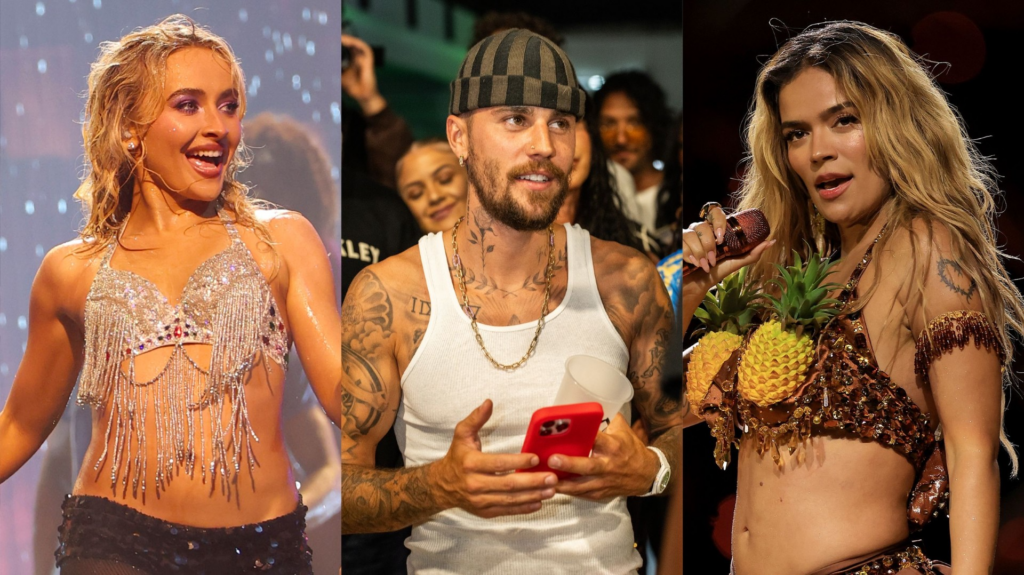
Despite my qualms with the commercialisation and over-priced features of Coachella, every year the festival produces some fantastic viral moments. In this sense, Coachella 2026 was no different, fuelling online discourse such as Bieberchella, the Sabrina Carpenter incident, and, my favourite, The Strokes’ second weekend performance.
Bieberchella:
Justin Bieber remains one of the most successful childhood stars of our generation, with a career spanning twenty plus years. Like many other child stars, Bieber has had to deal with large amounts of media and paparazzi attention. Leading many to dispute the morality of following celebrities as they grow up having their every move watched and judged by millions of people.
In this vein, online discourse of his Coachella performance saw many arguing that he was ‘healing his inner child’, and demonstrating that performers do not need a massive production of sound, lighting, and set to create a successful, engaging performance.
Furthermore, in an era where social media and the entertainment industry necessitate a constant online presence, with an increasing number of phones out recording at concerts, Bieberchella exemplified a moment where the audience came together to recognise the bare foundations of live music: a man, on YouTube, projecting his music, with only a couple of backing guitars.
Yet, is this a double standard? Do other artists in the music and performance industry, particularly women, not get bashed for doing the very same thing?
Female artists come in a package of costume, lights, set, dance routines, vocals, and high-energy performances. With the rise of a new generation of pop-stars in the works, the array of critical, conservative, and varyingly misogynistic commentaries are also increasing. Are these scantily dressed female artists, with “provocative dance moves”, being held to the same standards as their male counterparts?
Sabrina Carpenter:
What better way to exemplify this phenomenon than in Sabrina Carpenter’s juxtaposing headliner act. The Guardian commented that Carpenter “got the assignment” with her “elaborate on-stage world-building and cinematic videography”, seen in SABRINAWOOD in big, bold letters plastered across the stage.
Without doubt, Sabrina Carpenter put on a show with a full-scale production, costume changes, a developed plot, and stellar vocals. Does this not make you ponder not just the insane double standards in the music industry, but also the incomprehensible amount of money, time, and resources that go into fulfilling the expectations people hold for performers and pop-stars today?
Yes, live music is supposed to be entertainment, wowing audiences and fans, but are such levels of performance necessary? Or is it just expensive overkill?
This is coming from someone who very much enjoys Sabrina Carpenter’s music and performances, but who also was shocked when learning of the supposed seven months of dedicated work she put into creating and curating her Coachella set.
Carpenter also fell deep into hot water following her first weekend show, after she was labelled ignorant and “culturally insensitive” for calling a fan’s Zaghrouta (an Arabic celebration call) yodelling and “weird”.
The backlash she faced as a result of this raises two questions: firstly, should celebrities be held to a higher benchmark of cultural awareness than the ordinary person, as they exist in the public sphere? And if so, when invariably forced to apologise, educate themselves, and learn from their mistakes, is that enough? Do celebrities carry a higher duty of ensuring social and cultural sensitivity? Or is the ‘Sabrina Carpenter incident’ just an example of the absurdity of idolising celebrities that occurs in the media and in online spaces.
The Strokes:
In their set at the second Coachella weekend, The Strokes joined the growing list of artists using their platform to voice their opposition to ongoing conflicts. The indie-pop band closed their set with their 2016 song ‘Oblivius’, criticising and condemning the CIA and US government for their involvement in the death or ousting of world leaders on a huge screen.
The video montage played whilst lead singer Julian Casablancas sang the lyrics “What side you standing on?”, and ended with footage of 30+ universities in Iran being destroyed by US-Israeli airstrikes, alongside the demolition of al-Israa University in Gaza in 2024.
In the days following, The Strokes were praised online for their political commentary, questioning whether such forms of activism should be common for all artists and performers.
This begs the question do public figures and celebrities have a natural duty to engage in protest and campaigns? This example also contributes to the ongoing debate about the political nature of music and music festivals, particularly in light of the recent Eurovision competition.
Whilst many artists and performers argue that these events are ‘apolitical’, music and competitions are inherently political, and cannot be separated from wider contexts.
Existing in a public space, and having such a far reach for their words and actions, artists must arguably take advantage of their platform and influence to advocate for those who cannot.