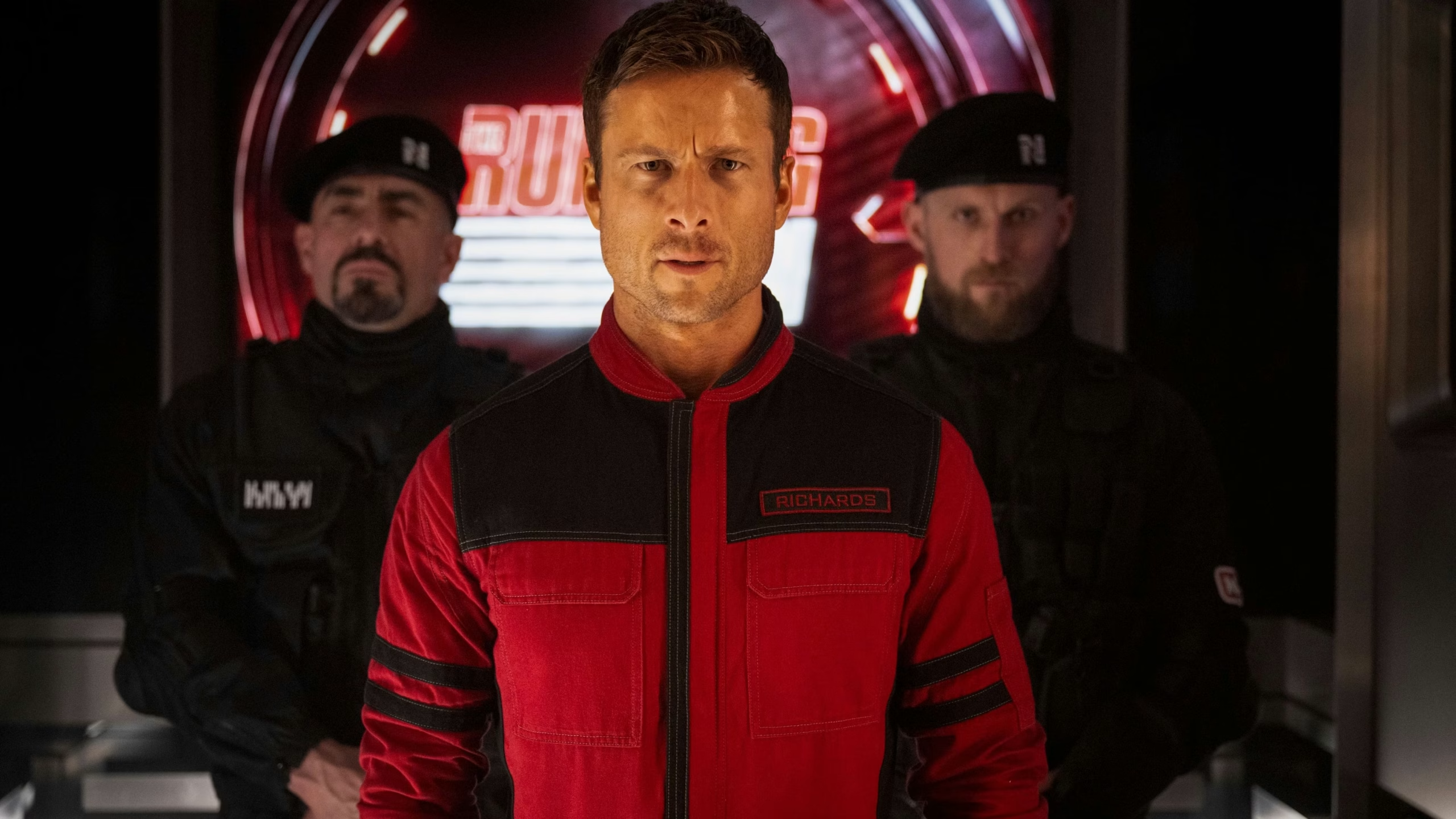
Pictured: Glen Powell as Ben Richards in ‘The Running Man’ (2025)
Image Credits: Heute.at
The Running Man (2025), directed by Edgar Wright, is a remake of the film with the same name released in 1987; both films are adaptations of the Stephen King Novel released in 1982. The new film’s plot, which far more closely resembles that of the Novel than the 80s film does, is set in a dystopian society in which the majority of America is controlled by a major corporation called ‘The Network’.
In this Universe, Ben Richards (Glen Powell), a union worker living with his wife and child in the aptly named ‘Slumside’, has been blacklisted from all work due to his union activities. When Richards’ infant daughter becomes ill and needs medicine, Richards signs up for the only job left to become a contestant on ‘The Running Man’, a show in which the Runner has to survive 30 days without being killed to win 1 billion dollars. The catch is now the whole country is on the hunt and wants you dead!
When King wrote the novel under the pseudonym Richard Bachman, he intended it as a critique of private corporations accessing areas that produce necessities for American citizens, as seen in the control of health care. As well as this, King saw reality TV as a tool to nullify the masses and order society along neat narratives. Taken to the extreme, both the book and this recent film paint a dystopian, terrifying not in its ludicrous future but horrifying in the reality of modern corporatisation.
Richards is one of the only still active workers’ union members, something frowned upon in an America which voted to make unions illegal in a promise that a more fluid class system would emerge. This reality never emerges in this universe, seen in the world building throughout the book’s events; the working class are left to live in decaying towns and the aforementioned slumside regions of major cities, whilst being physically gated off from the wealthy districts.
Due to Richards’ blacklisting, which is implied to be a carefully planned decision by the Network, which has constant surveillance access to every home in the country, he is forced to join The Running Man competition. In this, we see the second element of the themes in this book, the use of The Running Man is a clear depiction of how TV is often used for political persuasion, as said throughout the film by the Network show Runner, Dan Killian (Josh Brolin doing a great performance as slimy Billionaire), the truth is irrelevant to what keeps people entertained.
In respect to the show as a narrative tool, we further see the use of censorship, as whilst the runners have no choice, they are presented to the world as lowlifes trying to scam the ‘American dream’ and make it to the top. This manufactured hate is shown throughout the film and the book’s plot as it infects people, turning people against each other in order to ensure their obedience.
The film purposely updates many elements of the original book. Additions like the use of AI to make deep fakes to provoke public outrage make this film feel violently relevant despite its source material’s age. The styling of ‘The Running Man’ also reflects that of modern reality TV, solid as a channel exclusive with hundreds of seasons and spin-offs to pacify as the Network sells people both shackles and key. They welcome violence for profit. Each person in the show has a price on their head, even the public, to keep the carnage rolling.
All of the characters are shown to be confronted by the truth of the world. Richards, who is originally reluctant to aid in the revolution is radicalised when the truth of the world is slowly revealed to him by the those who help him try and win the show, like the Guerilla radio host, Bradley (Daniel Ezra) and Elton Parrakis (Micheal Cera), whose dad was killed by the Network for standing against the privatisation of public services like the police.
Our villains, Dan Killian and the Showrunner (Colman Domingo), act as the personification of the elites who ensure the status quo keeps the money in and the blood flowing, both unprepared for when the revolution finally catches them. The most unique of the cast, in my opinion, is that of our physical antagonist the Hunter called McCone (Lee Price) who hunts Richards he is the Network’s greatest mascot and when revealed to be the only running man winner show us the corruption that turns those against the system into weapons of commodity being replaced by the Network when no longer fitting the brand.
In contrast to its 1987 counterpart, this film is far more involved in debates around privatisation, authoritarianism and rising inequality. Whilst the new film does have its own issue, I for one think its ending of revolution seems quite hollow, it’s leagues better than the film directed by Paul Michael Glaser version, which, whilst entertaining, feels far less relevant to today’s political issues. The original film is more focused on Police authoritarianism instead of corporate oligarchs. In such, Ben Richards (Arnold Schwarzenegger) is a ‘good cop’ in a bad cop world, its satire, unlike the original, feels mainly flat and outshined by more politically aware films like Robocop, which was released in that same year.
In an age of such rampant corporate greed and misinformation, the Running Man feels all the more relevant. If the Running Man’s story tells us anything, it is that in the modern day, the revolution won’t be televised. In fact, it is our dependency on the channels of communication that are controlled by morally corrupt elites who care more about profit margins than people’s lives, which may televise our slide into authoritarianism.
If the film and the book ask of its audience one thing it is to seek the truth and stand up for each other because those who look down on you will never want to see you rise up.