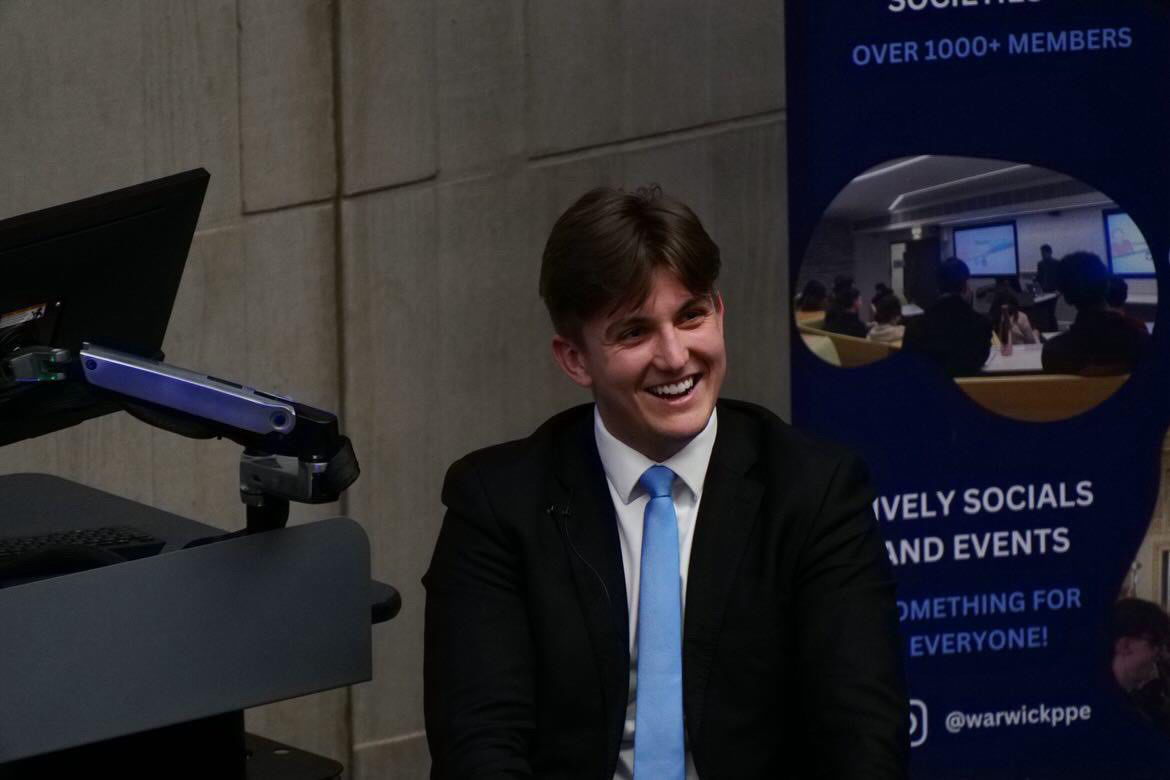
Image credits: Warwick PPE Society
George Finch’s visit to campus went as many expected, with divisive language, blatant racist dogwhistles and simplistic answers, characteristic of Finch’s rhetoric.
He is an unserious and cynical politician who spent 15 minutes talking about the local issues that impact the people he represents, and the rest of the hour and a half-long event dishing out culture war politics and Reform UK lines.
Ultimately, the event simply confirmed the casual bigotry and divisive politics that Reform represents.
The enormous controversy over the event began when Warwick PPE Society invited Finch to campus as an example of “Youth in Politics”, in a now-deleted Instagram post. One of the first issues is that Finch is hardly representative of young people in politics. He became council leader effectively by accident after his predecessor resigned, and scraped through a tied vote of his fellow councillors after the Tories abstained and the opposition parties couldn’t get full attendance. Reform is also a fringe party amongst younger voters – with just 9% of 18-24 year olds intending to vote for them, and 76% instead choosing one of the three progressive parties,
Controversy over the talk deepened as PPE initially chose to only allow preselected questions, although they allowed for an unscripted event after a backlash. This allowed for Finch to be properly held to account, which the audience and in fairness to them, the PPE exec and moderators, certainly managed to do.
Nevertheless, I’d argue it would have been best if this event had never taken place. Firstly, there’s no precedent for a council leader to be invited to speak on campus – to my knowledge, no previous leaders of Coventry or Warwick District Councils have been invited on campus by a society. Evidently, Finch wasn’t invited because of his position in local government, or the fact that he is a young person in politics, of which there are many others, but instead because he was a controversial figure and a member of a divisive political party.
It’s important to look at exactly what Reform UK represents. Reform’s policies include the abolition of Indefinite Leave to Remain (ILR), including for all recipients currently settled within the UK, and the imposition of a salary requirement of around £60,000 to apply for a visa to stay. This appalling policy would result in the mass deportation of hundreds of thousands of people who followed the rules and simply do not have the privilege of earning more than 80% of the population.
Alongside this, Reform is committed to leaving the ECHR, repealing both the Equality Act and the Human Rights Act, disapplying the UN Convention against Torture and the 1951 Refugee Convention, and even deporting unaccompanied children. Farage himself has spread divisive and hateful rhetoric, accusing Muslims of “split loyalties”, describing Andrew Tate as an “important voice for young men”, and condemning same sex marriage laws.
George Finch and all members of Reform UK obviously have the same right to freedom of speech that we all have, and Finch has a right to hold his views and express them accordingly. However, he does not necessarily have a right to a public platform to do so.
This is far from a matter of shutting down dissenting views: I’m sure that most readers of this magazine strongly disagree with the Conservative Party on a range of issues, but multiple Conservative MPs come to campus every year, and those events proceed without any controversy. The difference is that those speakers are not coming to spread hate and division, and there has to be a limit of acceptability in deciding who to host.
The Reform Party, in their policies and rhetoric, express absolute contempt for the diversity that characterises this university, and the hatred that they spread towards so many that go to Warwick should not be amplified or legitimised. Finch refused to reject any of this, and hosting Reform UK, as if they were just like any other political party, risks normalising them, and that is an incredibly dangerous action.
The event proceeded pretty much as one would expect it to. Finch started off with questions about local issues, and in his replies, for a brief moment, he seemed like a vaguely normal individual. Then, as expected, everything went wrong.
Finch spiralled upon being challenged about Reform’s right-wing economic policies, Reform’s opposition to any of the positive changes made to workers’ rights, and the imprisonment of their former Welsh leader, Nathan Gill, for taking bribes from the Kremlin. In a tirade that had basically nothing to do with the question asked, he ranted about how Labour had failed the working class, that the British State was supporting illegal migrants coming in in small boats, and then lied about how two million migrants came to the UK last year. Unfortunately for Finch’s strange version of reality, net migration was actually 204,000, a perfectly sustainable level and similar to most other high-income countries.
Finch struggled with the facts throughout most of the rest of the talk. We came onto the topic of ‘DEI’, an American culture war that Reform UK has cynically imported for political advantage. Finch seemed to have a complete lack of awareness of the fact that racism and sexism exist above the interpersonal level, and was unable to acknowledge that systemic factors serve to make life more difficult for marginalised communities. Instead, he made the weird argument that inclusion policies are racist against White people, and the Left is trying to control what people think.
The far-right in Britain has a problem when it comes to dealing with objective reality – from climate change, to migration, crime and even vaccines. George Finch managed to make this abundantly clear to all of us who attended.
When Finch wasn’t fighting his own personal war against the truth, he was either being racist, or a hypocrite. He argued that Sarah Pochin’s comments that she was driven mad by adverts “full of black and Asian people”, weren’t racist, and were just part of having a respectful debate.
Showing respect was obviously not too important to him, since immediately afterwards he stated that towns and cities in the UK were changing beyond recognition as a result of migration. This was a pretty blatant racist dogwhistle, taking the reality of demographic change and framing it in a negative light – as if having people from a non-white background in a town was somehow something bad.
It’s really quite difficult to work out what public interest having Finch at the university served. It wasn’t about free speech – after all, what kind of free speech event would have the police called on protestors outside?
It wasn’t about learning from his experience, given that he is younger than most of the audience and fell into his position by accident. And it wasn’t about hearing from diverse perspectives, since he lied throughout the event, devaluing everything he said.
Yet, there was one positive to this shambles. The vast majority of students at the event challenged Finch on the hatred that his party spreads on a daily basis, and the peaceful protests outside demonstrated that campus is not a welcoming environment for the far-right.
That is something that all of us at Warwick should be proud of.