Image credits: Alex Gold
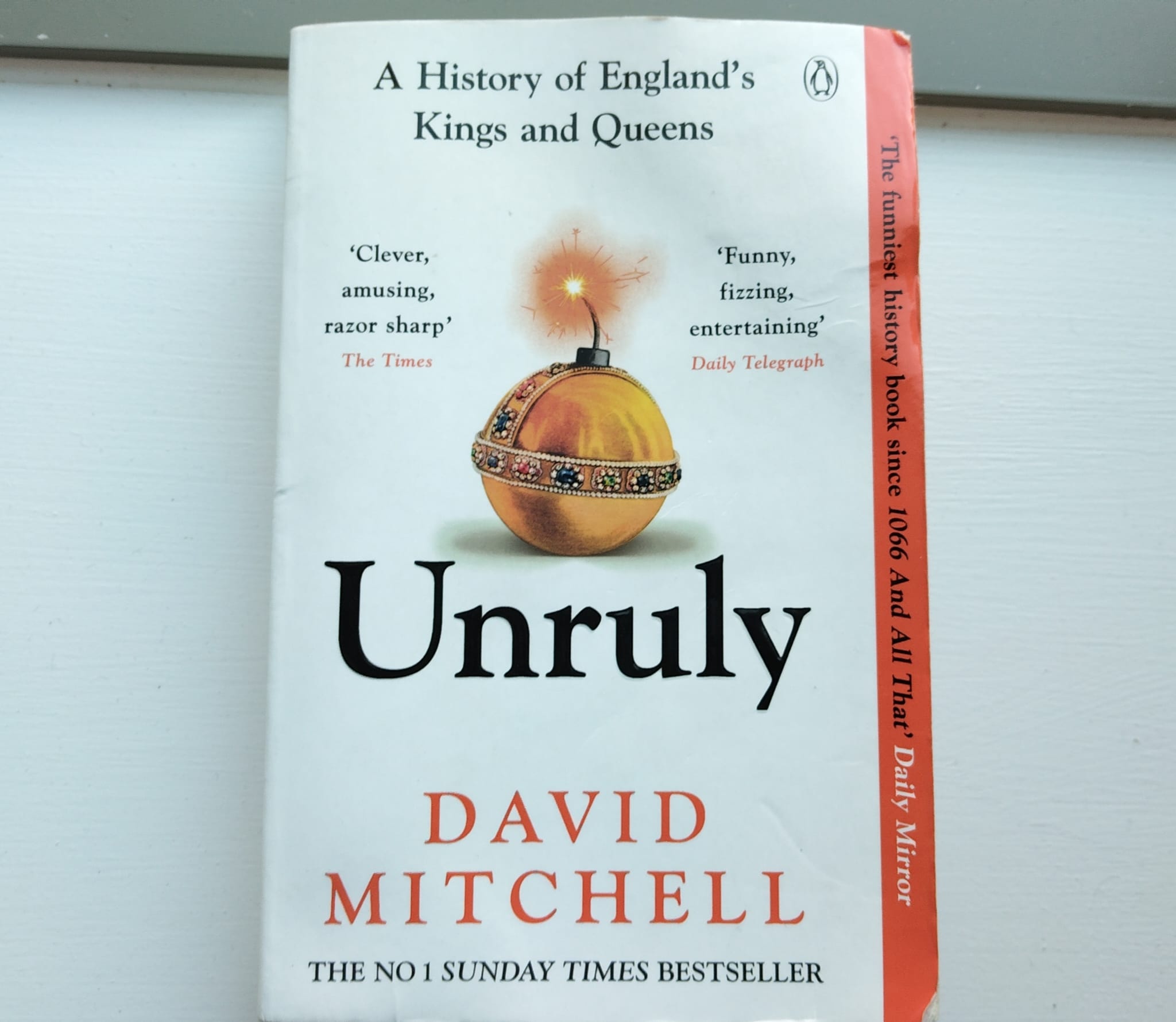
As the title of the article suggests, this is not your average, bland book review. This particular review aims to frame a book about Medieval Kingship by an upper-middle-class comedian from Oxford, in the wider context of contemporary British politics.
By examining the tenuous nature of our leaders’ political mandates due to our rigid adherence to tradition (the most significant preserve of history), we will see how David Mitchell’s Unruly is not merely a book about old kings. Instead, it tackles political issues faced by Medieval rulers and modern-day leaders alike.
Taking his reader through several centuries of early English Kingship (long before England existed as a concept), Mitchell jovially, wittily and anecdotally recounts the misadventures and misfortunes of King Arthur (who didn’t in fact exist), through to Elizabeth I (who did exist – but wasn’t nearly as successful)! Along the way, the reader gains delightfully detailed (often too detailed) insights into the ebb and flow of each King’s (and two Queens’) reign. Together, both author and reader analyse wider questions of legitimacy, stability, and the legacy left by the (completely falsified) notion of royal lineage – which retains a significant role in British politics today.
Described by The Guardian as ‘part Horrible Histories, part jolly romp guided by Alan Bennett’, this book comes highly recommended with a rating of 4.13/5 on Goodreads, and is perfect for avid History geeks who seek to recapture that nostalgic notion of history by memorising the entirety of the Horrible Histories Monarch Song. Why are you looking at me?
Mitchell justifies ending his book at the death of Elizabeth I by claiming: ‘The great era of English kingship is over’. This is a reasonably accurate claim, and it benefits the reader by giving them a greater understanding of how democracy, legitimacy and political rights were developing – several hundreds of years before they became institutionalised into the system of modern British government. Parliament itself was first convened in 1236, during the reign of Henry III. Yet this was largely made possible by the signing of the Magna Carta (of which we’ve all heard in a ‘yeah, okay we get it’ kind of way) by King John I, twenty-one years earlier.
The Magna Carta is a fundamental source of the British Constitution, but Mitchell’s irreverent interpretation of it reads: ‘The great British tradition of liberty, Magna Carta and Parliament, are methods for dealing with kings who turn out to be arseholes or idiots…[but] it does make a certain amount of sense: accept who the king is, but rein him in so he can’t screw things up too badly’.
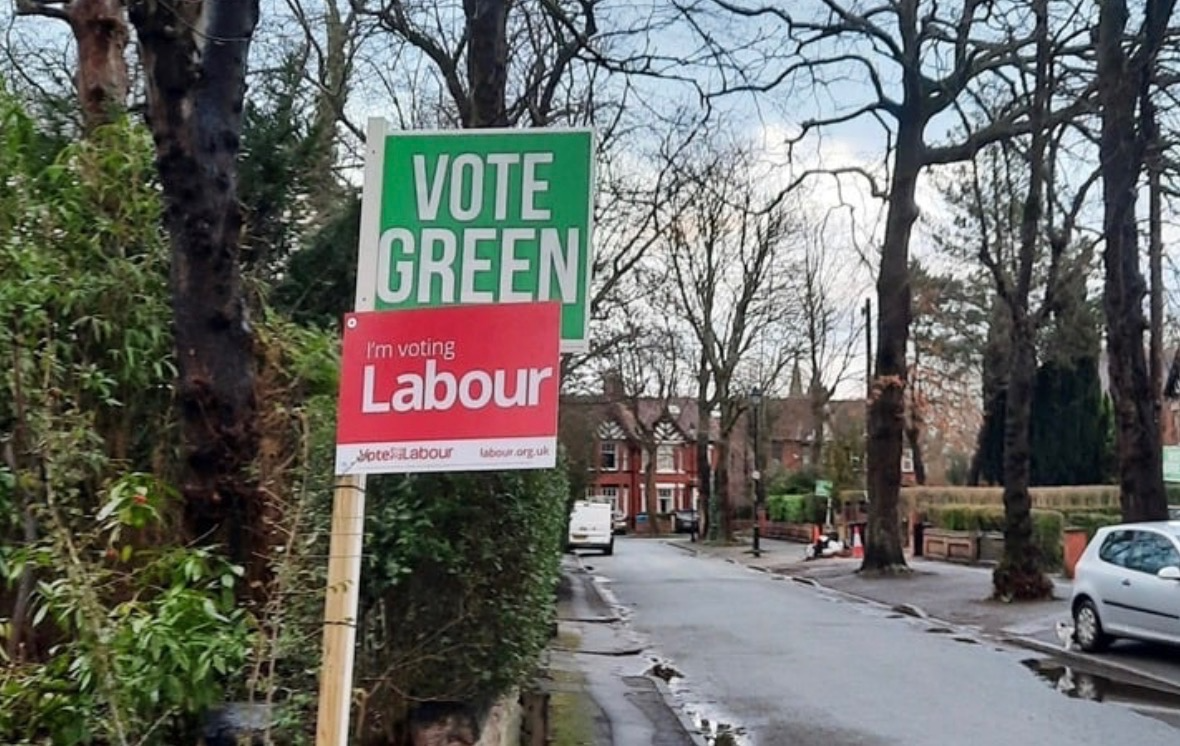
While nowadays, the only power left in royal hands is a symbolic façade of purely nominal authority – this same notion holds in the way the British public views majority governments (who have ultimately replaced the monarch in the possession of genuine power). Recently, the UK has elected two governments with overwhelming majorities – one led by Boris Johnson in 2019, and the other by Keir Starmer in 2024. At surface level, this appears to be a good thing; the PM’s ability to garner a broad mandate from their electorate is an indication that the years of legitimacy struggles faced by Medieval kings was worthwhile, as they ultimately established a stable and traditional institution of government.
However, Mitchell’s description of the ‘innate fondness’ with which British people view tradition is the principal producer of political instability from within a seemingly stable Western democracy.
Both the Johnson and Starmer governments promised considerable change for the UK. Yet what they both failed to realise is that for their voters, change sounds wonderful in theory, but detestable in practice. In the same way that Henry I is known to posterity as a successful king who provided economic stability, we have come to expect our Prime Ministers to do whatever needs to be done to allow the majority to live comfortably, so long as that doesn’t mean the M&S FoodhallTM in the town centre is knocked down and replaced with accommodation for asylum seekers.
It is this very sense of ‘things aren’t what they used to be’ that amplifies Nigel Farage’s voice. It is this unnecessary veneration of tradition, which has led to widespread criticism of Starmer’s (political) legitimacy – just as Henry IV faced in 1399 when he usurped Richard II for the House of Lancaster.
Ultimately, I don’t really know what conclusions we are meant to draw from all of this. Furthermore, I am aware that I have used this book review as an excuse to rant about the unwieldy presence of tradition in contemporary British politics – the same tradition which keeps the latest vainglorious pretender on the English throne, as I write this article.
As Mitchell notes on his final page, ‘They’re not important, they’re random. We had but mistook them all this while’. In my opinion, this applies to British monarchs and British Prime Ministers alike. So while I do not mourn the reduction in powers of the monarchy, my argument is the following: the precedence of history is not a determiner of the future.
Why then, do we continue to temper our leaders’ visions for meaningful change, with the dubious lessons of British history?