
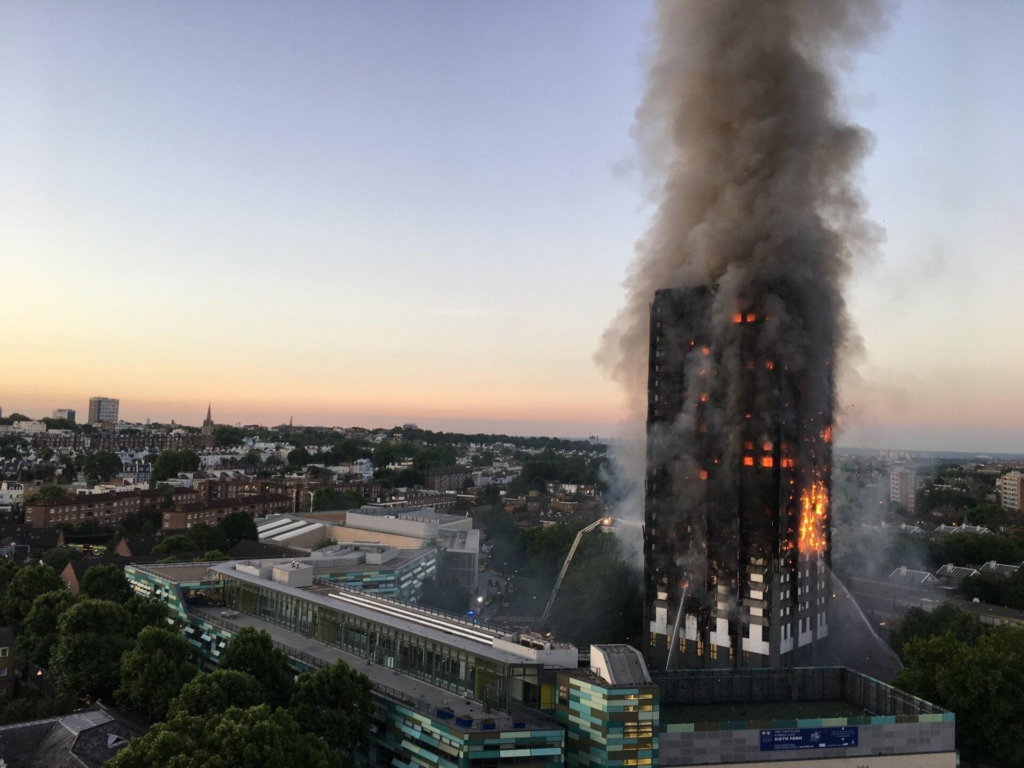
Imagecredits: https://commons.wikimedia.org/wiki/File:Grenfell_Tower_fire_(wider_view).jpg
Nine years after the Grenfell Tower fire claimed 72 lives, Britain continues to remember. Every June, green hearts appear across London, politicians issue statements, newspapers publish retrospectives, communities gather to honour those who lost their lives to one of the worst residential fires in modern British history.
Yet each anniversary raises an uncomfortable question: what does it mean to remember Grenfell when so many of the issues it exposed remain unresolved?
Last month, prosecutors announced that charging decisions relating to the fire may not be made until 2027, a whole decade after the disaster. Meanwhile, dozens of individuals and organisations remain under investigation. For survivors and bereaved families, justice continues to feel frustratingly distant.
The lack of convictions is undoubtedly a failure of the legal system. But after nine years, it also begins to feel like a failure of political will.
Grenfell exposed how difficult it can be to hold powerful institutions accountable, especially when responsibility is spread across governments, regulators, local authorities and private companies. That diffusion of responsibility has made legal accountability painfully slow.
The longer this process drags on, the harder it becomes to maintain public faith that justice will ever arrive. At some point, delayed justice stops feeling like justice delayed and begins to feel like justice denied.
But Grenfell was never only about accountability. It was also about what kind of society Britain had become.
Long before the fire, residents had raised concerns about safety within the building. Those concerns were repeatedly dismissed. Members of the Grenfell Action Group even warned that it would take “a catastrophic event” before the problems were taken seriously.
In the years since, the public inquiry has revealed a story of cost-cutting, regulatory failures, and a disregard for residents’ warnings, ultimately concluding that every death was avoidable.
The fire was not simply the consequence of one faulty product or one bad decision. It reflected years of political decisions about housing, regulation and public spending that created the conditions in which such a disaster could occur. To reduce Grenfell to a tragic accident is to overlook the political choices that made it possible.
This is why the Grenfell anniversary remains politically significant nearly a decade later, the disaster forces necessary, but uncomfortable, conversations about housing, inequality and austerity. Years of spending cuts and deregulation did not cause the fire on their own, but rather shaped the environment in which residents’ concerns could be repeatedly overlooked and building safety compromised.
Grenfell is a stark reminder that political decisions made over many years can have life-and-death consequences. It reveals how those living in social housing can find themselves excluded from decisions that directly affected their safety.
If Grenfell exposed anything, it was that safety is never simply a technical issue—it is also a political one. Whose voices are heard, whose concerns are dismissed, and where governments choose to invest, all shape who is protected and who is left vulnerable.
According to recent figures, more than 1,600 residential buildings in London still have fire safety defects. While the circumstances may differ from Grenfell, the statistic raises an obvious question: if the lessons have been learned, why do so many problems remain?
Anniversaries are moments to reflect on progress, yet these figures suggest that reform has been far slower than was promised. It is difficult to celebrate the lessons of Grenfell when thousands of people continue to live in buildings with serious fire safety concerns. Commemoration matters, but it cannot become a substitute for meaningful change.
Perhaps this is what makes memorialising Grenfell so difficult.
It has never faded from public memory, yet it has never really been resolved. Every anniversary brings renewed promises that justice will come and that the lessons have been learned. Yet with no convictions and thousands of people still living in buildings with fire safety defects, those promises increasingly ring hollow.
The problem is not that Britain lacks memorials to Grenfell. The green heart has become one of the most powerful symbols of remembrance in recent British history. Rather, Britain often seems more comfortable remembering Grenfell than confronting what it revealed.
Britain has become remarkably good at remembering Grenfell. It has been far less successful at responding to what Grenfell revealed.
A meaningful memorial to Grenfell should not only commemorate the 72 lives lost. It should also represent a commitment to ensuring the failures exposed by the disaster are not repeated. Until then, each anniversary remains a reminder of unfinished business.
Perhaps that is the real legacy of Grenfell. A tragedy cannot truly be memorialised while its underlying failures continue to shape the present.
Nine years on, Britain remembers Grenfell. Whether it has learned from it is a far more difficult question


Leave a Reply